Bitcoin's Rally Is Broken. But Is the Bottom Already In?
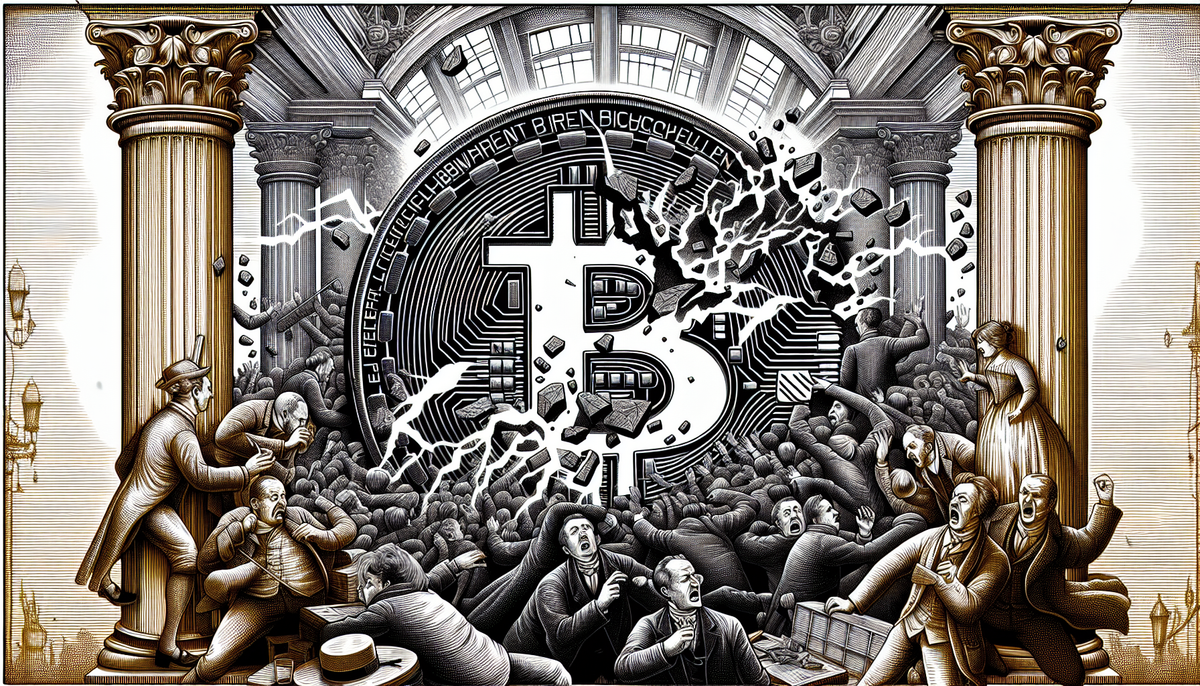
The crypto Fear and Greed Index just hit 5. That's not a typo. Five. We haven't seen numbers that low since the 2022 crypto winter, and before that, the COVID crash of March 2020.
Bitcoin is trading around $67,800 as I write this. It's down roughly 45% from its October highs. And if you've been watching the charts, you know it's about to post its fourth consecutive red week.
So let's talk about what's actually happening here. Because the news isn't all bad. In fact, some of it is really good. And the market doesn't care.
THE MARKET THAT WON'T LISTEN
BlackRock just announced it's making shares of its $2.2 billion tokenized treasury fund BUIDL tradable on Uniswap. That's the world's largest asset manager taking a concrete step into DeFi. Not talking about it. Not publishing a whitepaper. Actually doing it.
UNI jumped 25% on the news. And within 48 hours? Those gains evaporated.
Ark Invest bought $18 million worth of crypto stocks on Thursday alone. That's their 10th consecutive day buying Bullish exchange equity. Cathie Wood stood on stage at Bitcoin Investor Week and called bitcoin a hedge against both inflation and deflation. She thinks we're headed for "deflationary chaos" driven by AI, and that bitcoin is the escape hatch.
Crypto executives got named to the CFTC advisory group. The SEC chief said durable crypto policy requires the market structure bill to pass. A key Senate Democrat said he wants it to move forward.
And still. The price drops. Investors don't care.
Danny Nelson from Bitwise Research put it simply: "The market's main driver right now is fear. Good news doesn't register with investors. If they see an exit ramp, they're taking it."
WHERE THE FLOOR MIGHT BE
Jean-David Pequignot, Deribit's chief commercial officer, said something worth paying attention to at Consensus Hong Kong. He called bitcoin's long-term rally "broken" until the price reclaims $85,000. Below that level, the path of least resistance is down.
That's a painful thing to hear when we're sitting at $67,800.
But here's what matters. Pequignot sees $60,000 as a major psychological support level. Big buy walls have historically formed there. If $60K breaks on a closing basis, the next stop is the 200-week moving average, sitting near $58,000.
That 200-week MA is basically the bitcoin bottom-fishing bible. Every significant bear market since 2015 has found its low near that average. Traders watch it religiously. And right now, it's right there at $58K.
So the range to watch is $58,000 to $60,000. If we get there, expect serious buying pressure. If that doesn't hold, we've got a much bigger problem.
THE MACRO STORM
It's not just crypto. The Nasdaq fell 2% on Wednesday. The S&P 500 dropped 1.6%. And it's dragging everything down with it.
Bitcoin has this frustrating habit of being uncorrelated with stocks when they go up and perfectly correlated when they go down. That pattern showed up again this week.
The trigger? Stronger than expected payroll data made traders rethink rate cut expectations. CPI data for January drops today, and the consensus estimate is 2.5% year over year. If it comes in hotter, expect another wave of selling.
And then there's the government shutdown. Kalshi prediction markets put the odds of a partial shutdown starting tomorrow at roughly 90%. A shutdown during a crypto bear market with extreme fear readings is about as fun as it sounds.
Standard Chartered's Geoff Kendrick, who used to be one of the bigger bitcoin bulls, slashed his 2026 targets this week. He's now warning bitcoin could dip to $50,000 before recovering.
Coinbase missed fourth quarter estimates. Transaction revenue came in below $1 billion. The stock dropped over 8% on Thursday. Robinhood had already confirmed earlier that the crypto bear market chewed through trading volumes in Q4.
COINBASE EARNINGS TELL THE REAL STORY
Look, I think Coinbase's earnings miss says more about the market than any chart analysis can.
When the biggest publicly traded crypto exchange reports declining transaction revenue, it tells you real people are pulling back. Not just retail speculators. Institutional trading desks. Market makers. Everyone.
Wall Street analysts from JPMorgan and others cut their Coinbase price targets after the report. JPMorgan noted that "weak crypto markets pressured fourth quarter results." But they also backed Coinbase's strategy of investing through the cycle and returning capital via buybacks.
That second part matters. The smart money isn't leaving the building. They're just acknowledging it's cold outside.
WHY I'M NOT PANICKING
Here's my honest take. A Fear and Greed reading of 5 has historically been a signal, not a warning. Every time we've hit single digits on that index, it marked a period near a local bottom. Not necessarily THE bottom. But close.
The 200-week moving average at $58K isn't some random number. It's backed by a decade of price data showing it catches falling knives better than anything else in crypto.
Cathie Wood's "deflationary chaos" thesis actually makes sense to me. AI training costs are falling 75% per year. Inference costs are dropping 98% annually. If that kind of deflation hits the real economy, traditional financial systems aren't built for it. Bitcoin, with its fixed supply and no counterparty risk, starts looking very different in that world.
And the regulatory picture has never been better. Pro-crypto officials at the CFTC. A willing Senate. An SEC chief who understands the stakes.
The price action is ugly. I won't pretend otherwise. We could absolutely see $58K or lower before this is over. But the fundamentals underneath this market are stronger than the fear suggests.
If you're a long-term holder, the question isn't whether $67,800 is the bottom. It's whether you think bitcoin will be worth more than this in two years. I think the answer is obviously yes.
And if history is any guide, the best time to buy is exactly when it feels the worst.
Just don't expect it to feel good while you're doing it.